Menu
Insight
ICRA 2026 Recap

Robotics startups raised nearly $14B in 2025, up from $8.2B the year before, and past even the $13.1B peak back in 2021. The industry is moving faster than it ever has, so it’s worth taking a look at what’s actually changed, and what hasn’t, in the 8 months since the last big robotics conference (IROS 2025 Hangzhou).
ICRA, the IEEE International Conference on Robotics and Automation, is one of the field’s flagship academic conferences, and this year it was in Vienna. That matters more than it sounds. IROS Hangzhou drew a large turnout from the robotics scene across China and East Asia. A European venue attracts a pretty different crowd. A lot of the smaller Asian teams that showed up in Hangzhou didn’t make the trip out, and in their place you got a bunch of smaller European groups with some genuinely interesting hardware. So it’s not a perfect apples-to-apples comparison, but it's still worth making.
No new hardware, by design
No real new hardware was introduced in the past 8 months. This makes sense. The physical AI hardware space is getting increasingly crowded (some would say unhealthily so), and the focus for 2026 isn’t on building new hardware; it’s on getting the existing embodiments into more commercial channels. You can see it in how the bigger hardware vendors positioned themselves at the show:
Unitree didn’t have much of a presence. Seems like they no longer need to do tradeshow marketing, given how prominent they already are in the field.
AGIBOT had a huge presence, with a booth, a second booth for their spinoff, and their own competition track.
Booster was aggressively pushing sales of their small (0.6m) humanoid.
Sharpa continued their CES narrative, positioning themselves not just as a dexterous hand manufacturer, but a full robotics solution provider.
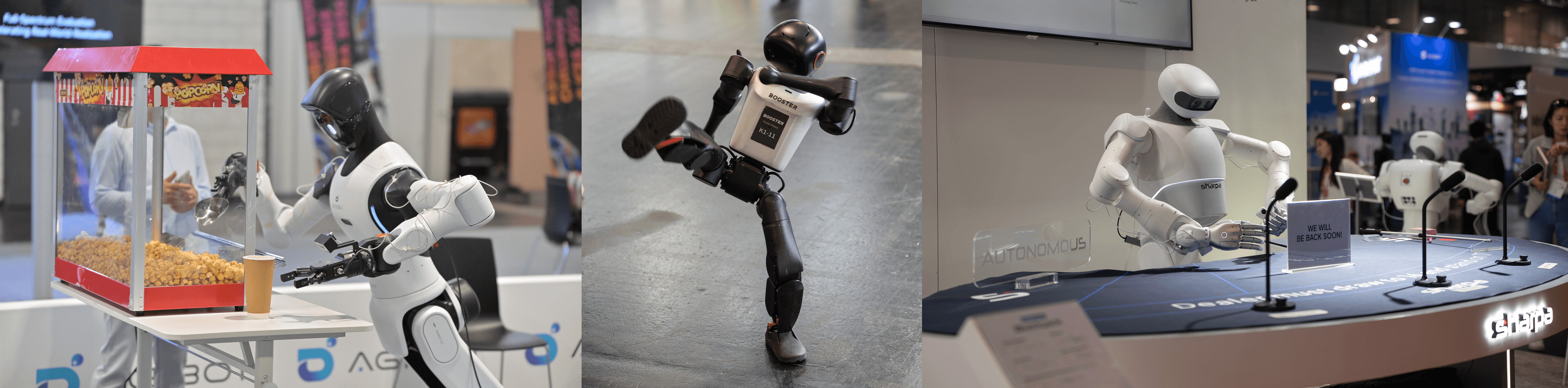
No venture-funded Western hardware companies showed up, which reflects current attitudes toward competitive positioning.
The biggest winner by far, though, was Universal Robots. UR benefits from the fragmentation in the QDD/low-cost robot arm space the same way Apple benefits from all the competition in the Android market. If you’re only 10% of the market but the other 90% is split among 100 vendors, then your single-brand presence is 10x theirs. UR made a much bigger appearance at ICRA than at IROS, and between that and a smaller Chinese presence, the unmistakable UR blue was everywhere you looked.
Hardware learns software
A handful of the hardware vendors also had foundation model demos. These were by no means scratch-trained or commercial-grade models, but after the buzz that Dyna’s clothes-folding demo made at CES, a ton of copycats showed up at ICRA.
The goal isn’t for the hardware companies to start selling foundation model weights. It’s to show that their particular embodiments can be used for foundation modeling - selling to the labs building these models is a growing part of the market.
Fewer companies were showing off teleoperation this year, but I think that’s mostly geography and isn’t reflective of any real industry trends.
Data vendors emerge
As physical AI keeps moving from in-house data collection to external data collection, a number of data shops emerged from the woodwork with ICRA booths. That’s a stark contrast to IROS, where the only pure-play data company was Lightwheel.
The most notable arrival was Encord, a well-established data vendor entering the robotics market. Talking to their booth staff, it sounds less like a brand-new pivot and more like something they’ve been quietly doing for a while now. They’ve been handling white-glove robotics data behind the scenes, and ICRA is where they decided to say it out loud. Either way, it’s a useful signal.
The simulation folks were there as usual, though a fair number of the physical AI sim companies are shops pivoting out of gaming/XR into what they see as a hot new narrative. Outside of Lightwheel, it’s not always clear how well these companies actually understand what robotics data is.
Other points of interest
The first heavy-lift Chinese manipulators have emerged. Galbot was showcasing a robot with a purported 50 kg payload.
Drones seem to have reappeared! By simply rebranding as flying robots, drone companies can now share in the narrative.
EU dynamism seems to be going strong. A number of the companies on the show floor had Eurocentric narratives.
UMI and other “rogue modalities” are emerging, with several UMI hardware vendors at this year's show. Pricing, however, left something to be desired.
Where this leaves us
Put it all together, and ICRA 2026 felt less like a hardware show and more like an industry growing up. The robots themselves are mostly settled at this point. The money and the attention have moved on to getting them into real commercial use, and to the data layer that makes them worth anything once they’re out there. The question isn’t whose robot can pull off the demo anymore. Most of them can. It’s whose robot still works on the thousandth try in a room nobody set up for it in advance.
More to explore



Menu
Insight
ICRA 2026 Recap
Robotics startups raised nearly $14B in 2025, up from $8.2B the year before, and past even the $13.1B peak back in 2021. The industry is moving faster than it ever has, so it’s worth taking a look at what’s actually changed, and what hasn’t, in the 8 months since the last big robotics conference (IROS 2025 Hangzhou).
ICRA, the IEEE International Conference on Robotics and Automation, is one of the field’s flagship academic conferences, and this year it was in Vienna. That matters more than it sounds. IROS Hangzhou drew a large turnout from the robotics scene across China and East Asia. A European venue attracts a pretty different crowd. A lot of the smaller Asian teams that showed up in Hangzhou didn’t make the trip out, and in their place you got a bunch of smaller European groups with some genuinely interesting hardware. So it’s not a perfect apples-to-apples comparison, but it's still worth making.
No new hardware, by design
No real new hardware was introduced in the past 8 months. This makes sense. The physical AI hardware space is getting increasingly crowded (some would say unhealthily so), and the focus for 2026 isn’t on building new hardware; it’s on getting the existing embodiments into more commercial channels. You can see it in how the bigger hardware vendors positioned themselves at the show:
Unitree didn’t have much of a presence. Seems like they no longer need to do tradeshow marketing, given how prominent they already are in the field.
AGIBOT had a huge presence, with a booth, a second booth for their spinoff, and their own competition track.
Booster was aggressively pushing sales of their small (0.6m) humanoid.
Sharpa continued their CES narrative, positioning themselves not just as a dexterous hand manufacturer, but a full robotics solution provider.
No venture-funded Western hardware companies showed up, which reflects current attitudes toward competitive positioning.
The biggest winner by far, though, was Universal Robots. UR benefits from the fragmentation in the QDD/low-cost robot arm space the same way Apple benefits from all the competition in the Android market. If you’re only 10% of the market but the other 90% is split among 100 vendors, then your single-brand presence is 10x theirs. UR made a much bigger appearance at ICRA than at IROS, and between that and a smaller Chinese presence, the unmistakable UR blue was everywhere you looked.
Hardware learns software
A handful of the hardware vendors also had foundation model demos. These were by no means scratch-trained or commercial-grade models, but after the buzz that Dyna’s clothes-folding demo made at CES, a ton of copycats showed up at ICRA.
The goal isn’t for the hardware companies to start selling foundation model weights. It’s to show that their particular embodiments can be used for foundation modeling - selling to the labs building these models is a growing part of the market.
Fewer companies were showing off teleoperation this year, but I think that’s mostly geography and isn’t reflective of any real industry trends.
Data vendors emerge
As physical AI keeps moving from in-house data collection to external data collection, a number of data shops emerged from the woodwork with ICRA booths. That’s a stark contrast to IROS, where the only pure-play data company was Lightwheel.
The most notable arrival was Encord, a well-established data vendor entering the robotics market. Talking to their booth staff, it sounds less like a brand-new pivot and more like something they’ve been quietly doing for a while now. They’ve been handling white-glove robotics data behind the scenes, and ICRA is where they decided to say it out loud. Either way, it’s a useful signal.
The simulation folks were there as usual, though a fair number of the physical AI sim companies are shops pivoting out of gaming/XR into what they see as a hot new narrative. Outside of Lightwheel, it’s not always clear how well these companies actually understand what robotics data is.
Other points of interest
The first heavy-lift Chinese manipulators have emerged. Galbot was showcasing a robot with a purported 50 kg payload.
Drones seem to have reappeared! By simply rebranding as flying robots, drone companies can now share in the narrative.
EU dynamism seems to be going strong. A number of the companies on the show floor had Eurocentric narratives.
UMI and other “rogue modalities” are emerging, with several UMI hardware vendors at this year's show. Pricing, however, left something to be desired.
Where this leaves us
Put it all together, and ICRA 2026 felt less like a hardware show and more like an industry growing up. The robots themselves are mostly settled at this point. The money and the attention have moved on to getting them into real commercial use, and to the data layer that makes them worth anything once they’re out there. The question isn’t whose robot can pull off the demo anymore. Most of them can. It’s whose robot still works on the thousandth try in a room nobody set up for it in advance.
More to explore
Menu
Insight
ICRA 2026 Recap
Robotics startups raised nearly $14B in 2025, up from $8.2B the year before, and past even the $13.1B peak back in 2021. The industry is moving faster than it ever has, so it’s worth taking a look at what’s actually changed, and what hasn’t, in the 8 months since the last big robotics conference (IROS 2025 Hangzhou).
ICRA, the IEEE International Conference on Robotics and Automation, is one of the field’s flagship academic conferences, and this year it was in Vienna. That matters more than it sounds. IROS Hangzhou drew a large turnout from the robotics scene across China and East Asia. A European venue attracts a pretty different crowd. A lot of the smaller Asian teams that showed up in Hangzhou didn’t make the trip out, and in their place you got a bunch of smaller European groups with some genuinely interesting hardware. So it’s not a perfect apples-to-apples comparison, but it's still worth making.
No new hardware, by design
No real new hardware was introduced in the past 8 months. This makes sense. The physical AI hardware space is getting increasingly crowded (some would say unhealthily so), and the focus for 2026 isn’t on building new hardware; it’s on getting the existing embodiments into more commercial channels. You can see it in how the bigger hardware vendors positioned themselves at the show:
Unitree didn’t have much of a presence. Seems like they no longer need to do tradeshow marketing, given how prominent they already are in the field.
AGIBOT had a huge presence, with a booth, a second booth for their spinoff, and their own competition track.
Booster was aggressively pushing sales of their small (0.6m) humanoid.
Sharpa continued their CES narrative, positioning themselves not just as a dexterous hand manufacturer, but a full robotics solution provider.
No venture-funded Western hardware companies showed up, which reflects current attitudes toward competitive positioning.
The biggest winner by far, though, was Universal Robots. UR benefits from the fragmentation in the QDD/low-cost robot arm space the same way Apple benefits from all the competition in the Android market. If you’re only 10% of the market but the other 90% is split among 100 vendors, then your single-brand presence is 10x theirs. UR made a much bigger appearance at ICRA than at IROS, and between that and a smaller Chinese presence, the unmistakable UR blue was everywhere you looked.
Hardware learns software
A handful of the hardware vendors also had foundation model demos. These were by no means scratch-trained or commercial-grade models, but after the buzz that Dyna’s clothes-folding demo made at CES, a ton of copycats showed up at ICRA.
The goal isn’t for the hardware companies to start selling foundation model weights. It’s to show that their particular embodiments can be used for foundation modeling - selling to the labs building these models is a growing part of the market.
Fewer companies were showing off teleoperation this year, but I think that’s mostly geography and isn’t reflective of any real industry trends.
Data vendors emerge
As physical AI keeps moving from in-house data collection to external data collection, a number of data shops emerged from the woodwork with ICRA booths. That’s a stark contrast to IROS, where the only pure-play data company was Lightwheel.
The most notable arrival was Encord, a well-established data vendor entering the robotics market. Talking to their booth staff, it sounds less like a brand-new pivot and more like something they’ve been quietly doing for a while now. They’ve been handling white-glove robotics data behind the scenes, and ICRA is where they decided to say it out loud. Either way, it’s a useful signal.
The simulation folks were there as usual, though a fair number of the physical AI sim companies are shops pivoting out of gaming/XR into what they see as a hot new narrative. Outside of Lightwheel, it’s not always clear how well these companies actually understand what robotics data is.
Other points of interest
The first heavy-lift Chinese manipulators have emerged. Galbot was showcasing a robot with a purported 50 kg payload.
Drones seem to have reappeared! By simply rebranding as flying robots, drone companies can now share in the narrative.
EU dynamism seems to be going strong. A number of the companies on the show floor had Eurocentric narratives.
UMI and other “rogue modalities” are emerging, with several UMI hardware vendors at this year's show. Pricing, however, left something to be desired.
Where this leaves us
Put it all together, and ICRA 2026 felt less like a hardware show and more like an industry growing up. The robots themselves are mostly settled at this point. The money and the attention have moved on to getting them into real commercial use, and to the data layer that makes them worth anything once they’re out there. The question isn’t whose robot can pull off the demo anymore. Most of them can. It’s whose robot still works on the thousandth try in a room nobody set up for it in advance.